
Azure Outage August 2025 suffered a major global outage that briefly brought parts of the internet to its knees. The disruption affected millions of users and thousands of businesses that rely daily on Microsoft’s cloud infrastructure from small startups to massive enterprises.
For a few tense hours, websites went dark, authentication systems failed, and cloud-hosted applications simply stopped responding. It was a sobering reminder that even the biggest names in tech are not immune to failure.
Table of Contents
When the Cloud Went Quiet
The trouble began on August 12, 2025, just before 2:00 AM UTC, when administrators in Europe and North America started reporting slow connections and login errors on their Azure dashboards. What initially looked like a minor glitch soon evolved into a full-blown outage.
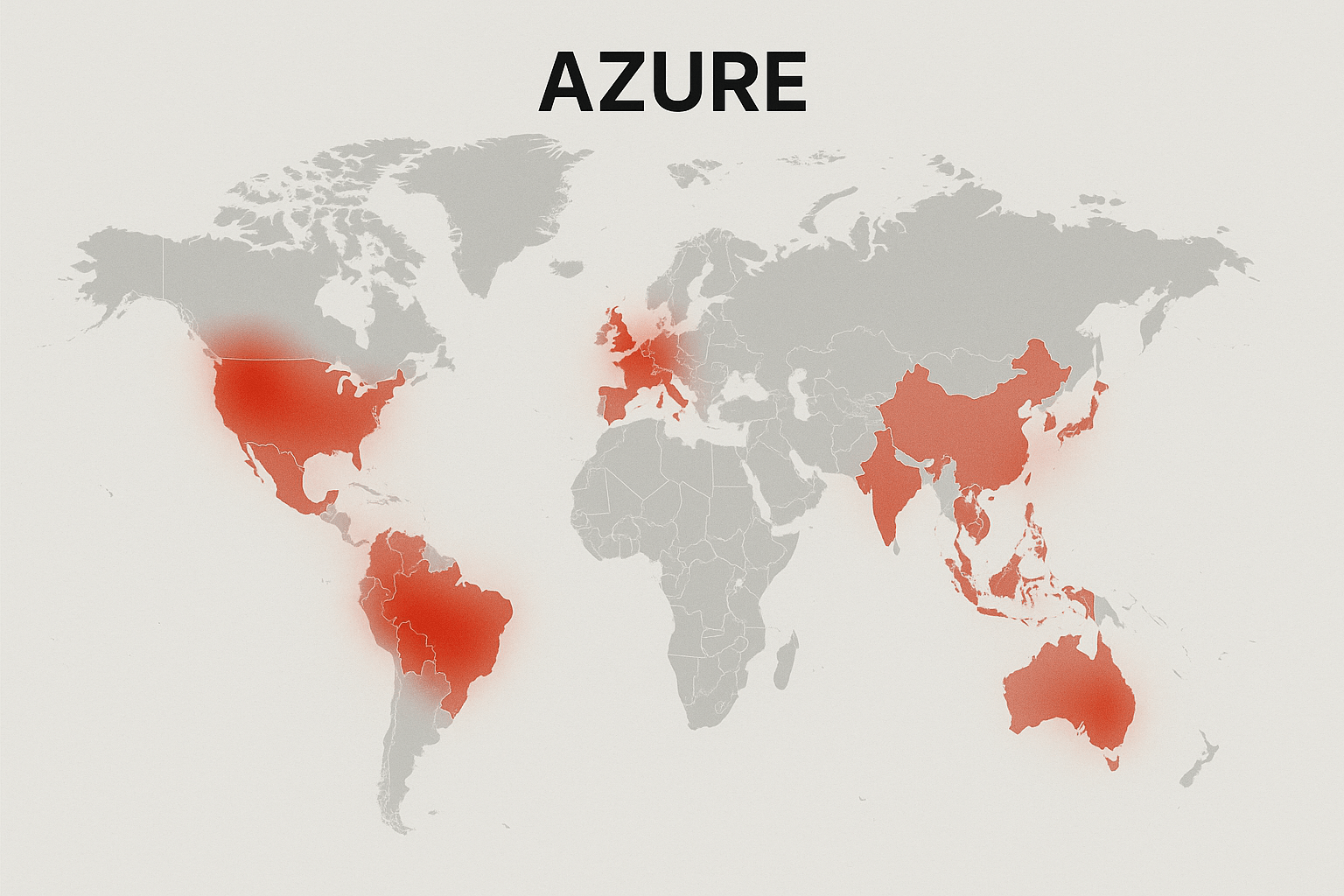
Within an hour, Azure services across East US, North Europe, and Southeast Asia began failing simultaneously. Microsoft’s status page confirmed that several key products including Azure Virtual Machines, SQL Databases, and Microsoft Entra ID (formerly Azure Active Directory) were experiencing widespread service degradation.
By mid-morning, reports of downtime flooded developer forums, Reddit, and X (formerly Twitter). Businesses relying on Azure for hosting, data storage, and identity management all faced the same reality: their systems were offline, and there wasn’t much they could do but wait.
Services Hit the Hardest
The outage had a ripple effect across Microsoft’s ecosystem. Popular products built on Azure such as Office 365, Dynamics 365, and Power Platform also suffered interruptions. Users reported not being able to sign in, sync data, or access cloud-stored files.
Some of the most widely reported issues included:
- Azure Virtual Machines: Instances freezing or disconnecting entirely.
- Azure SQL Database: Websites and apps unable to load user data.
- Azure Entra ID: Users locked out of third-party logins integrated with Microsoft’s identity layer.
- Azure DevOps: Builds and pipelines stuck indefinitely, halting deployments worldwide.
For developers, it was more than just an inconvenience it was a global standstill.
Microsoft’s First Response
Microsoft acknowledged the issue early in the day, stating:
We’re aware of a global connectivity issue impacting multiple Azure services. Our engineering teams are investigating the cause and working to restore access.
Behind the scenes, Azure engineers were racing to find the root cause. Early indicators pointed toward a problem inside Azure’s core networking layer the private global backbone that connects Microsoft’s 60+ data center regions.
By 06:00 UTC, Microsoft confirmed the disruption was linked to a firmware glitch in core routing equipment, which created communication failures between regional clusters.
Sixteen Hours of Chaos
Partial restoration began by 09:30 UTC, though full recovery across all Azure regions didn’t happen until nearly 17:30 UTC. In total, the outage lasted roughly 16 hours, one of the most extensive interruptions Microsoft has faced in years.
While some regions, like West Europe and Central India, came back online earlier, dependent services such as authentication and storage lagged behind. Developers reported having to restart workloads manually even after Azure dashboards showed “fully operational” status.
The long duration of the outage prompted concerns about Azure’s failover resilience and whether its global redundancy systems were sufficient to contain large-scale disruptions.
#AzureDown Trends Worldwide
The incident quickly went viral. The hashtag #AzureDown dominated tech spaces on X, while discussions on Reddit’s r/sysadmin community turned into live troubleshooting threads.
Some users expressed frustration about the slow communication in the early hours:
We noticed downtime before Microsoft even updated the status page, one developer posted.
Others took a more sympathetic view, pointing out that outages of this scale are incredibly complex to resolve. Despite the frustration, many appreciated Microsoft’s transparency once details began to emerge.
Official Follow-Up from Microsoft
Later that day, Microsoft released a follow-up update explaining that:
A firmware-related issue in networking infrastructure triggered cascading connectivity problems across several Azure regions. Services are being restored in phases, and we’re implementing safeguards to prevent recurrence.
This statement confirmed what many had suspected the problem wasn’t a cyberattack or a software exploit, but a technical fault in internal networking hardware. Still, it exposed the challenges of running a hyperconnected cloud infrastructure where a single failure can ripple globally.
What Analysts Observed
Industry analysts were quick to weigh in. Many pointed to Azure’s tight inter-region dependencies, which can amplify the impact of networking failures. Others speculated about update automation suggesting that a firmware patch may have been deployed too widely without proper staged validation.
It’s rare for something like this to slip through Microsoft’s safeguards, noted one cloud reliability engineer. But when you operate at this scale, even the smallest fault can have massive consequences.
The Calm After the Storm
By evening, Azure services were mostly stable again. Microsoft’s engineering teams had rolled back the faulty firmware and isolated the affected clusters. Businesses began restoring normal operations, and developers slowly resumed deployments.
Yet the damage was already done. Many organizations faced hours of downtime, missed transactions, and disrupted user experiences. Some small businesses even reported losing clients due to the interruption.
For a platform that powers everything from streaming services to financial systems, the August 2025 outage became a case study in how fragile global cloud dependencies can be.
What Comes Next
Microsoft confirmed that a detailed post-incident report would be released within 48 hours, outlining the root cause, recovery process, and preventive measures. Early insiders hinted that Azure’s firmware validation protocols and region isolation design were already under review.
For now, the incident stands as one of Azure’s most significant tests of resilience and a warning for companies relying exclusively on a single cloud provider.
Azure Outage August 2025, What Really Happened Inside Microsoft’s Longest Cloud Disruption
When the dust finally settled after the Microsoft Azure outage of August 2025, engineers, IT teams, and entire businesses were left wondering how a platform trusted by half the internet went silent for most of a day.
Microsoft’s official post-incident summary landed a week later. Beneath the polished language, one thing was clear a small firmware update on a few switches managed to pull the plug on a global cloud.
How It All Started
It began like any other maintenance cycle. A firmware upgrade was quietly pushed to Azure’s core network switches, meant to improve routing efficiency. Instead, it unleashed a hidden bug that sent data packets looping endlessly through the backbone a digital echo chamber that overloaded the system.
Engineers expected regional isolation to contain such faults, but this time, isolation broke. The bug spread beyond its intended boundaries, cutting off connections between regions that normally act as backups for one another.
A rare firmware anomaly triggered routing instability outside the expected containment zone, Microsoft admitted.
No, it wasn’t a cyberattack. It was the classic domino effect of modern cloud design: so interconnected that one misstep ricochets across the world in seconds.
The Global Fallout
By mid-morning UTC, businesses in Europe and North America started reporting login failures and unresponsive virtual machines. Within hours, Azure dashboards across continents glowed red.
- Enterprise apps froze. Companies relying on Azure VMs and SQL Databases faced 6-to-10 hours of downtime.
- Microsoft Entra ID (Azure AD) went down, locking users out of Microsoft 365, Teams, and countless third-party services.
- Developers’ pipelines halted. Continuous-deployment systems couldn’t reach APIs.
- Even public agencies and hospitals in some countries reported temporary data-access issues.
Analysts later put the global downtime losses near $150 million, though many agree the real cost was the trust that evaporated during those silent hours.
Inside the Recovery Room
Once the bug was pinned down, Microsoft engineers rolled back the firmware and isolated affected clusters. The recovery unfolded like a controlled emergency:
- Cut off faulty routes to stabilize the backbone.
- Revert switches to the last known good build.
- Resync data centers one region at a time.

By evening, most services were back. Still, Microsoft wasn’t taking any chances. Within days it promised three major changes:
- A pre-deployment simulation system to test firmware on live-traffic models.
- Better regional containment, so one failure can’t ripple worldwide.
- Real-time health alerts on the Azure Status Page for full transparency.
These weren’t just fixes they were public proof that Microsoft had learned a painful lesson in cloud resilience.
What Experts Are Saying
Industry voices had mixed reactions. Some applauded Microsoft’s openness; others saw it as a warning about the complexity of hyperscale systems.
Dr. Lin Zhang, cloud researcher at Stanford, summed it up:
The outage reminds us that reliability is never a finished project. It’s an ongoing fight against complexity.
Start-ups, especially in fintech and SaaS, said the incident accelerated their plans for multi-cloud deployments.
We used to think Azure alone was enough, said Rafael Cortez, CTO of a European fintech firm. Now we’re splitting workloads between Azure and AWS just in case.
Damage Control: Money and Reputation
SLA credits will offset some losses, but analysts at IDC believe Microsoft faces tens of millions in claims. Yet, the reputational dent may prove harder to repair.
AWS and Google Cloud wasted no time offering migration deals to affected clients. Still, most enterprise users say they’ll stick with Azure, partly because of its deep link to Windows Server, Microsoft 365, and enterprise authentication stacks.
In the end, transparency helped. By posting detailed timelines and acknowledging mistakes, Microsoft softened the backlash.
What Businesses Should Learn
If the Azure outage taught the cloud community anything, it’s that dependence without backup is a risk no company can afford. A few hard-earned lessons stood out:
- Adopt multi-cloud or hybrid models. Even giants fail. Diversify workloads.
- Rehearse recovery plans. Many teams found out their DR drills were outdated.
- Don’t rely solely on SLAs. Credits won’t recover lost transactions or reputation.
- Keep customers informed. Silence during downtime hurts more than the outage itself.
A Reality Check for the Cloud Wars
Before August 2025, Azure boasted a 99.97 % uptime almost identical to AWS and Google Cloud. The new numbers will dip slightly, but few expect mass migration. Cloud dominance isn’t just about uptime; it’s about trust and ecosystem depth.
Still, AWS quietly rolled out a “Resilience Assurance” program right after the outage a subtle jab that didn’t go unnoticed.
Looking Ahead: Engineering for the Inevitable
If there’s a single takeaway, it’s that outages are inevitable in a system of this scale. What matters is how quickly and transparently a company bounces back.
Microsoft has already begun implementing multi-layer fail-safes and faster rollback tools. For users, it’s a reminder that cloud reliability isn’t a fixed number it’s an evolving promise.
As one Azure engineer wrote on Reddit after the chaos:
Every failure makes us stronger. It hurts, but it’s how resilience is built.
Final Thoughts
The Azure outage of August 2025 won’t just be remembered as a blackout, it’ll be cited in future textbooks as a case study in scale, complexity, and accountability.
For the rest of the tech world, it’s a nudge to review their own infrastructures not with panic, but with realism. Because in the cloud era, perfection isn’t the goal. Resilience is.
FAQ’s
Is there an Azure outage?
As of now, Microsoft Azure services are fully operational. The major Azure outage that occurred in August 2025 has been resolved, and systems are running normally. You can always check the current status on the official Microsoft Azure Status page.
Is there any Azure outage today?
No, there is no Azure outage today. Microsoft’s engineering team continuously monitors all regions, and any temporary service issues are usually reported instantly on Azure’s status dashboard.
What caused the Azure outage?
The August 2025 Azure outage was triggered by a firmware glitch in Microsoft’s core networking equipment. This technical fault disrupted communication between data center regions, causing widespread downtime for nearly 16 hours before full recovery.
Did CrowdStrike cause the Azure outage?
No, the Azure outage was not related to CrowdStrike. Microsoft officially confirmed that the disruption stemmed from an internal networking firmware issue, not a third-party security update or integration problem.
What caused the Azure outage (again for keyword variation)?
The root cause was a firmware update error in Azure’s backbone network switches. This led to routing instability and region-to-region communication failures, affecting multiple cloud services globally.
What is an Azure outage?
An Azure outage occurs when one or more of Microsoft’s cloud services, like Virtual Machines, SQL Databases, or Entra ID, become unavailable due to technical, network, or infrastructure failures. Outages can be regional or global depending on the scale of the issue.
Are there any outages in Azure in the US?
At the moment, there are no active Azure outages in the US. You can confirm live service availability by visiting Microsoft’s Azure Status Portal.
Can Azure VM outage happen?
Yes, Azure Virtual Machines (VMs) can experience temporary outages if there’s a problem with the underlying host, data center, or regional infrastructure. Microsoft uses redundancy and live migration systems to minimize downtime, but short disruptions can still occur.
Did CrowdStrike cause the Azure outage?
No, this has been clarified by Microsoft. The August 2025 outage was purely an internal networking issue, not connected to CrowdStrike or any third-party software vendor.
How to check Azure outage?
To check for any ongoing or recent Azure outages, visit the official Azure Status page. It shows real-time updates, affected regions, and service recovery progress. You can also subscribe to email or RSS alerts for your region.
Microsoft Azure’s outage highlights how even top-tier cloud systems can face unexpected downtime. For more cloud updates and tech insights, visit Tecknostat.